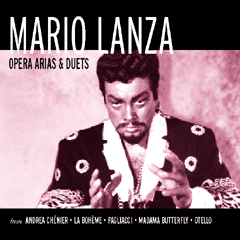
- "Mario Lanza: Opera Arias
And Duets"
-
-
-
-
-
- By Lindsay Perigo
editor@freeradical.co.nz
-
-
- If ever confirmation were needed - and
it isn't - of Placido Domingo's & Richard Leech's recently-stated estimates
of Mario Lanza's voice as the greatest they have ever heard (Opera News,
September, 1999), then the latest BMG/Derek Mannering collaboration, Mario
Lanza, Opera Arias & Duets, surely provides it. There is simply nothing
to compare with the glorious tones that pour forth from this new CD. Had
he lived in the pre-Christian era, Mario would have been assumed to be
a visiting god from Mt Olympus, where all the quintessential human attributes
were writ large in super-human personifications. Mario was super-human
- of that, in a non-mystic sense, there is no doubt. And like the super-human
Greek gods, he was imperfect. Nearly all the tracks on this CD betray flaws,
sometimes glaring ones - but these pale into insignificance alongside his
irresistible vocal & interpretative genius.
-
- Mr Mannering, bless him, seems to have
a penchant for starting his CDs with the weakest offering. On When Day
Is Done it was One Alone. On this CD it is Celeste Aida - definitely the
least impressive track here, & Mario's weakest recording of the aria
by far. But we should remember two things: 1) if we hadn't heard the others,
particularly the alternate Great Caruso take on the Rhino MGM CD, we would
assuredly embrace this one - the primordial excitement, the baritonal depth
combined with glorious tenor overtones, are all there; and 2) this was
recorded for the Coca Cola radio show as a one-off, in a hurry, not intended
for commercial release. Eight tracks on this CD are in this category. Given
this, it is amazing that so many of them are so good.
-
- The pinched final B-flat of Celeste Aida
gives way to a melting first few bars of Amor Ti Vieta, another Coke recording.
These tones are so beautiful one wishes Mario would sing the whole cantilena
in this fashion, but he quickly reverts to his characteristic full-throated
sound. No matter - when he hits the High A on "T'amo" all is
forgiven.
-
- Then comes one of the highlights, for
which Lanza fans have been waiting for so long - the Improvviso from Andrea
Chenier. Many years ago a fellow tenor-enthusiast & I sat down &
compared six performances of this aria, beginning with Caruso & moving
through Gigli & del Monaco & ending with Lanza. We followed the
text of the aria as each tenor sang & interpreted. My friend was not
especially enamoured of Lanza, but he said at the conclusion of the exercise,
"No question. That (Mario's) was the best." No question indeed.
Those who have heard Mario rehearsing this aria at home (Damon Lanza Productions
tape) will know how well Mario related to this aria, & appreciate how
fully he consummated his dedication to it in this commercial recording.
Again, there is simply nothing to compare with Mario's soaring conclusion,
"Amor, divino dono, non lo schernir, del mondo, anima e vita, e l'amor."
-
- O Soave Fanciulla from La Boheme follows
(there is noticeable distortion in this reproduction). One is immediately
struck by how much more baritonal Mario's voice is after the five years
between the Chenier recording & this one. Pity he wasn't actually present
with his partner, Jean Fenn, who dubbed in her contribution later - she
may have managed to seduce him into being more delicate in such phrases
as "Che m'ami di" as he was in his earlier Hollywood Bowl performances.
Still, while the final High C is a bit of a shriek for both of them, it
would bring the house down in a live performance.
-
- Then comes the Coke rendering of the
Flower Song from Carmen. Of Mario's several readings, this is the one for
me. Quite unlike anyone else's, & quite unlike his own other performances.
Soft & delicate, with his French quite exquisite in parts. The only
jarring note is the aspirating of the final "Je t'aime." Completely
unnecessary, & it throws Mario way off pitch.
-
- O Paradiso follows - here there is overlap
with BMG's previous Soundies CD. Readers should see my review of that on
this site.
-
- Un Tal Gioco. Chilling! Mario is in complete
charge of the script here - if my wife were to be unfaithful to me in real
life, as opposed to on the stage, look out! All the more remarkable if
one has heard Mario's ribald clowning around when rehearsing this number.
-
- Madam Butterfly duet. Again, see my review
of the Soundies CD.
-
- La Donna E Mobile. Another Coke recording,
more than adequate but not up to the standard Mario set in his recordings
for The Great Caruso. A terrific cadenza & concluding High B though.
-
- Vesti la Giubba (yet again!) Coke also,
& compelling in parts, but it doesn't begin to compare with the alternate
Great Caruso take on the Rhino CD which, to my ears, is the greatest Vesti
by anyone ever. This one here is too rushed, with Mario blurring the word
"Infranto" in the climactic phrase, "Sul tuo amore infranto."
And the overlaid applause at the end reveals that this track is not the
original master. Shame on you, BMG!
-
- M'appari from Marta. Gorgeous, but again
pre-empted by the Soundies release.
-
- Nessun Dorma. Never sounded better, reproduction-wise,
notwithstanding some distortion, but it is badly sung & should have
been done again. The opening is bleary & mispitched, the top notes
throughout are constricted, & Mario mispronounces "Tramontate"
in his re-entry as "Tremontate." Not good enough - but fans will
love it nonetheless!
-
- Testa Adorata. Outstanding! Mario at
his interpretative best, his voice infused with bright & dark colours
at will, his diction unfailingly clear.
-
- Come un bel di from Chenier. The above
comments re the Improviso apply here. Had Mario never gone to Hollywood,
but solely to the opera stage, it's likely that Chenier would have been
his defining role, much as Canio was Caruso's.
-
- Lamento di Federico. For me, the high
point of this CD. Mario's most lyric performance of this aria. He sings
the phrases "Vorrei poter tutto scordar" & "Perche d'eggio
tanto penar" without a breath, as they should be sung. He builds up
to a stunning High B climax & a concluding "Ahime!" that
only a heart of stone could resist.
-
- Finally, the much-vaunted Otello duet
with Licia Albanese. Actually, the encounter with Madame Albanese - and
it is truly a formidable one - occurs only between the words "Mollamente"
& "Vo fare amenda." Mario's singing on either side of these,
the closing Monologue included, is dubbed from his earlier preliminary
recording of the duet with soprano Gloria Boh. No matter. This is singing
that brings one to the edge of one's seat, & raises again all those
futile speculations as to what might have been. But "futile"
is the operative word. We cannot bring him back to do re-takes, either
of his recordings or of his life! We must settle for what was, & acknowledge
that OUR lives would be so much the poorer without it.
-
- Moreover, "settle" is far too
mean a word. This was truly the voice of the century, animated - to go
back to the Greeks - by what Aristotle would not have hesitated to call
a "great-souled one." One should not merely "settle for"
such a phenomenon; one should savour, celebrate & salute it. Thank
you, BMG & Derek Mannering, for furnishing another wonderful opportunity
to do so.
- __________________
Additional Comments
-
- From Clyde Smith <GreatLanza@aol.com>
- 10-27-99
-
-
- My first comment is that the title is
wrong: "Opera" is a noun, "Operatic" is
- an adjective, and "Aria" is
a noun. An adjective is used to modify a noun,
- so, the correct title should be: "Operatic
Arias And Duets."
-
- The following comments are only listed
by track number, for brevity:
-
- #1 Recorded 3-21-52
- #2 Recorded May 9 1952, take 2
- #3 This track suffers from hum, echo,
and a dull sound. The source tape used was obviously an old dub. My tape
sounds better than this CD
- #4 Take 1, and the recording date given
is only for Mario and the orchestra; #5 recorded March 6, 1952, take 3;
#6 Recorded April 8, 1950, this is not the August 4th take 1 #7 Recorded
May 9, 1952, take 8
- #8 Take 1
- #9 You will notice we are not subjected
to a butchered cadenza, as in
- the studio version
- #10 Recorded 6-15-51. Here we are treated
to strange noises for the first 7 seconds, and from 2:37 to the end. These
sound like transcription noises, as if the source was a transcription,
rather than have conducted a more exhaustive search was made of the tapes
for the original. Also, the applause was left in, when it should have been
deleted. #11 As in #6
- #12 Take 2
- #13 Recorded May 9, 1952, takes 4, 4a-d
- #14 As in #3
- #15 Recorded March 28, 1952, takes 3,
3a
- #16 Here there is a partial error of
the recording date; The first 9:20 was recorded on the date given, but
from 9:21 to the end, Mario's earlier recording session with Gloria Boh,
was used. You can hear Mario's voice become lighter or younger, at the
edit point. Also, they edited out Mario drawing a breath, at that point.
The recording date for the earlier session was July 19 and 21, 1955.
___________
-
-
- From Derek Mannering
5-5-99
-
- Once again I am delighted to announce
a new addition to the ever-burgeoning catalog of Mario Lanza CDs from BMG/RCA.
-
- This past year alone has seen the release
of two major collections on the RCA label: 'When Day Is Done' and the Living
Stereo 'Lanza Sings Christmas Carols.'
-
- In April, the wonderful 'Mario Lanza
in Hollywood' CD licensed from BMG to Soundies/DRG Records reached the
stores.
-
- Now comes 'MARIO LANZA: ARIAS OPERAS
AND DUETS'...the first-ever all-opera Lanza CD which will be released on
the RCA 'Red Seal' label in August, 1999. Sixteen newly-remastered tracks
are featured on the collection:
-
- Celeste Aida (Coca-Cola Show)
- Amor Ti Vieta * (Coca-Cola Show)
- Un Di All'azzuro Spazio (RCA)
- O Soave Fanciulla ('Serenade' soundtrack
- with Jean Fenn);
- Flower Song * (Coca-Cola Show);
- O Paradiso (RCA)
- Un Tal Gioco (Coca-Cola Show)
- Madama Butterfly: Love Duet (RCA - with
Elaine Malbin)
- La Donna e Mobile (Coca-Cola Show)
- Vesti la Giubba * (Coca-Cola Show)
- M'appari (RCA)
- Nessun Dorma ('Serenade' soundtrack)
- Testa Adorata (Coca-Cola Show)
- Come Un Bel Di Di Maggio (RCA)
- Lamento di Federico * (Coca-Cola Show)
- Otello Duet ('Serenade' soundtrack -
with Lica Albanese)
-
- * Previously Unreleased
-

-
- Mario recorded a wide variety of music
during his tragically-brief career but opera always remained his true love.
In choosing material for this collection, great care was given to selecting
arias and duets that capture some of the best and rarest examples of Lanza's
operatic output.
-
- Every track has been remastered from
the original recording source and high praise indeed must go to BMG's remastering
producer for the great care and technical skill he has lavished on each
selection. I think it is safe to say that we have never heard these recordings
in better sound.
-
- Sourcing some of the rarer recordings
was a particular joy. The two glorious"Chenier" arias recorded
for RCA in 1950 are surely the most sought-after operatic selections in
the Lanza archive; certainly, Mario never sang them better than here.
-
- Four previously unreleased tracks from
the Coca-Cola Shows are also featured, including a breathtaking "Lamento
Di Federico" and a gorgeous "Amor Ti Vieta."
-
- The fabulous Otello duet with the great
Licia Albanese brings the collection to a fitting close. I spoke with Madame
Albanese recently about that recording session, mention of which will be
made in the liner notes.
-
- As we all know, October 7th, 1999 sees
the saddest of anniversaries in the musical calendar. In the tributes and
remembrances to come, the release of "MARIO LANZA: ARIAS OPERAS AND
DUETS" will help ensure that one very significant aspect of a glorious
career will not be forgotten.
-
-
-Derek Mannering
- From Derek Mannering Thought you might
enjoy these 2 reviews of the Opera Arias & Duets CD...
-
- Classical Ireland Radio Review
-
- Mario Lanza was already a year dead when
Ramon Vargas was born. Early surrender to the lures of Hollywood ensured
that the American tenor never got to have an operatic stage career: nor
is it certain that he had the industry and stamina to have sustained one.
But at his best, and that includes some of the tracks on this CD, he
was a match for anyone. The content comes from three periods in Lanza's
short singing life. The least good are the over-miked and mannered radio
performances from 1952. But listen to how well he sings and acts - overacts,
maybe? - the long act 3 duet and monologue from Verdi's Otello, where
his Desdemona is Licia Albanese. That is taken from the soundtrack of
the 1957 film Serenade, although only the monologue was actually used in
the final print. There is also a sterling "Nessun dorma" from
the same source. The Jewels, however, are the two arias from Andrea Chenier,
recorded in 1950 and never available since then. Lanza's "Improviso"
is one of the best versions of this oft-recorded piece I know.
- John Allen
-
-
-
- Barnesandnoble.com Review
-
- Any self-respecting fan of the splashy
Hollywood tenor will already own his immortal renditions of "Be My
Love" and other pop classics. But Mario Lanza excelled at opera too,
and this compelling CD is chock full of arias by Verdi, Bizet, Leoncavallo,
and others. Lanza's lasting charms are clear in Giordano's "Amor ti
vieta," where he begins as a hushed, caressing suitor. By the triumphant
final note, we know the result of the lover's quest. "Federico's Lament"
from Cilea's "L'Arlesiana" is heartbreakingly autobiographical
singing, expressing a world of distress and personal tragedy. With duos
by able sopranos like the underrated Jean Fenn and Licia Albanese, (Toscanini's
MimÏ), this disc is an irresistibly moving experience for all Mario-philes.
- Benjamin Ivry
|