- Textbook theory of sunspot activity faces new difficulties
posed by the magnetically confined structures of the penumbra. The old
idea that the penumbra filaments are "convection currents" must
now give way to new evidence that electric currents dominate these solar
structures.
-
- We can thank the "Astronomy Picture of the Day"
folks for the two images above. They are from a brief sequence that can
be viewed as a movie by clicking the link below
-
- http://dot.astro.uu.nl/movies/morph20042909-color-small.mpg
-
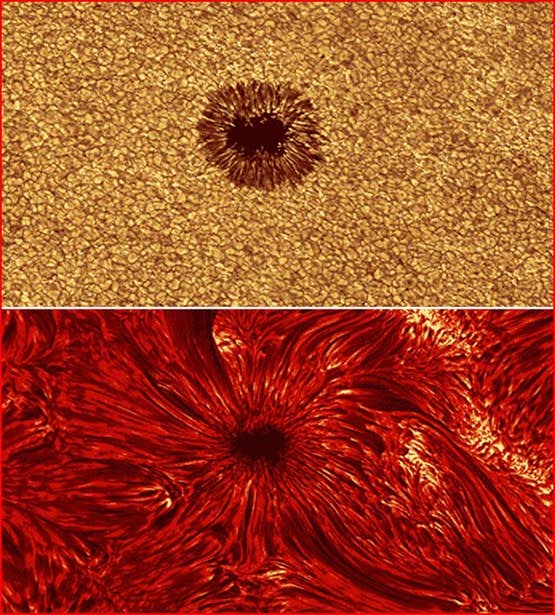
- The movie shows the sunspot in false-color images from
different heights above the surface or photosphere. The first image (upper
image in the picture above) shows the Sun's photosphere as it normally
appears, covered with granules. The large dark sunspot sports a clear dark
umbra in the center through which we can peer into the cooler region beneath
the surface. Surrounding the sunspot is the lighter penumbra, composed
of rope-vortices rising explosively from beneath the surface. In the linked
movie, the images appearing toward the middle of the sequence show what
is occurring a few hundred kilometers above the photosphere, as the twisted
filaments of the penumbra begin to spread out horizontally.
-
- The last image of the sequence (lower image above) shows
the Sun at a few thousand kilometers into the chromosphere, the layer of
the Sun,s atmosphere just above the photosphere. Here we see the "ropes"
of the sunspot penumbra extending outward into a surrounding maze of filaments,
all constrained by the complex magnetic fields that have so amazed and
entranced solar physicists in recent years.
-
- For decades, the standard model of the Sun treated the
penumbra filaments as "convection cells", columns of hot gases
transporting heat from the interior to the surface. Astrophysicists formulated
such concepts while under the spell of gravity and familiar gas laws. Seeing
the Sun as an isolated island in space, they had no other tools to work
with.
-
- But proponents of the Electric Universe assert that there
are no isolated islands in the universe. They contend that concepts of
simple heat transport are alien to the plasma discharge behavior evident
in sunspot activity. As Wallace Thornhill observed, the penumbra filaments
"bear no resemblance to any known form of convection in a hot gas,
magnetic fields or no".
-
- So we pose the question: what is controlling the behavior
of the penumbra in these pictures--magnetic fields or gas laws? The new
profile of the solar atmosphere has left the astrophysicists in a state
of ambivalence. The APOD folks do not describe the network of interacting
filaments as "convection cells". They say simply, "Here
magnetic field lines can be clearly followed outward from the sunspot to
distant regions". That is not the behavior of convection cells!
-
- The problem is that now the solar physicists appear to
have fallen under the spell of another popular fiction--the idea science
can appropriately discuss magnetic fields without concerning itself with
the cause. Now the refrain is, "Just look at all those twisted magnetic
fields!" The solar "experts" have forgotten first principles:
only electric currents produce magnetic fields. Yes, the complex magnetic
fields are there, and they are the predictable effect of "anode tufting"
or secondary discharging above the positively charged sphere in a glow
discharge. Link:
-
- "The Electric Glow of the Sun" http://www.thunderbolts.info/tpod/2005/arch05/050427sun.htm
-
- While the electric model of the Sun remains to be elaborated
in important details, sunspot activity is eminently suited as a critical
test. Where should one look for evidence of electron currents flowing into
the Sun? If, as Thornhill claims, the sunspot is the opening through which
discharge currents pass from the more negatively charged torus around the
Sun, then sunspot activity should be investigated systematically with an
entirely new vantage point in mind.
|