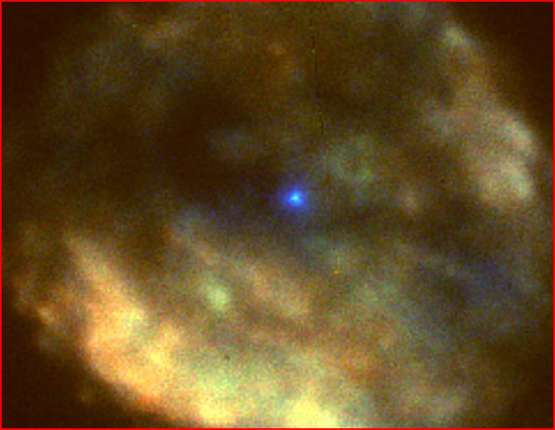
- Picture Above: XMM-Newton's view of supernova
remnant RCW 103
-
-
- More difficulties for the standard theory of supernovae
and "neutron stars" -- a misbehaving "supernova remnant."
-
- In the past few decades of space exploration, we have
grown accustomed to seeing certain words and phrases in the scientific
press release. It would be difficult or impossible to enumerate all of
the instances when space discoveries have been met with shock and perplexity
by mainstream investigators. "This is a complete surprise"..."This
should not be"..."We're not sure"...Given the confidence
with which the cosmological big picture is presented in scientific media,
one would think that such statements would be rare, but in fact, almost
none of the milestone findings of the space age were expected.
-
- Recently, astronomers announced the discovery of a "mystery
object" that, according to conventional wisdom, should be a very "young"
neutron star, yet behaves like one that is several million years old. According
to the Space.com report, "Embedded in the heart of a supernova remnant
10,000 light-years away is a stellar object the likes of which astronomers
have never seen before in our galaxy. At first glance, the object looks
like a densely packed stellar corpse known as a neutron star surrounded
by a bubble of ejected stellar material, exactly what would be expected
in the wake of a supernova explosion."
-
- But astronomers observed the star for just over 24 hours
with the European Space Agency's XMM Newton X-ray satellite, and were stunned
by what they saw. Its emission cycles were tens of thousands of times longer
than theory had postulated for "a freshly created neutron star."
-
- "The behavior we see is especially puzzling in view
of its young age, less than 2,000 years," said study leader Andrea
De Luca of the Istituto Nazionale di Astrofisica (INAF) in Milan. "For
years we have had a sense that the object is different, but we never knew
how different until now," De Luca said.
-
- Neutron stars are claimed to be the remnants of massive
stars -- bloated red supergiants -- that have collapsed after the expiration
of their "nuclear furnace," resulting in a supernova. This event
is said to explain the pulsar remnant of some supernovae. Pulsars exhibit
bursts of radiation up to thousands of times a second. To account for this,
astronomers imagined a super-collapsed stellar object, spun up by the collapse
like a skater pulling in his or her arms, emitting a rotating beam of x-rays
spinning like the beam of a lighthouse up to thousands of times per second.
-
- Conventional theory would say that the offending "neutron
star" in this case is spinning far too slowly for one of its imagined
age of a couple of thousand years. According to Electric Universe proponents,
this kind of contradiction is inevitable in the investigation of "neutron
stars", because they do not exist. They were a theoretical invention
based on a fundamental misinterpretation of the nature of stars, and hence
of supernovae.
-
- >From an Electric Universe point of view, stars are
formed in a plasma "pinch," one of the most common features in
the observed behavior of electric currents in plasma. Large magnetic fields
have been detected in galaxies, and these fields indicate that huge electric
currents flow in circuits through the galaxies. In fact, stars are both
sparked and powered by the same electric currents. Stars behave as electrodes
in a galactic glow discharge.
-
- The EU hypothesis is that supernovae are not caused when
a star loses its "nuclear furnace" and collapses, but rather
they are due to a catastrophic galactic electric discharge event focused
on a hapless star. And observation in recent years has only supported this
model. For example, supernovae occur with a periodicity in any given galaxy
that highlight their connectedness via galactic circuits. Stars are not
self-contained sources of energy.
-
- Supernova 1987A was the closest supernova event since
the invention of the telescope. (See Supernova 1987A decoded, http://www.holoscience.com/news.php?article=re6qxnz1)
It was doubly special because the progenitor had been examined before the
explosion. Electrical theorists say it was not a coincidence that this
"best example" violated all the "rules." The progenitor
was not the expected red supergiant star, but a BLUE supergiant, perhaps
20 times smaller than a red supergiant. Moreover, the structure of Supernova
1987A, with three axially aligned rings and a string of bright beads forming
the equatorial ring, has no place in the standard model of supernovae.
Everything about this exploding star, however, has direct counterparts
in laboratory experiments with high-energy plasma discharge. And plasma
cosmologists using electric circuit theory have explained all of the complex
features of the pulsing radiation from supernova remnants without the need
for a hypothetical "super condensed object" like a neutron star.
-
- The question now is, will astronomers continue to invent
more ad hoc exceptions to a theory already too complicated by exceptions,
or will they pause sufficiently to wonder if a new perspective is possible
on the burgeoning zoo of supernovae types and odd "neutron stars?"
-
- Thanks to Wallace Thornhill for much of the scientific
content of this piece.
|