- As I write, Russia is waging war on my country, Tbilisi,
Georgia.
-
- On Friday, hundreds of Russian tanks crossed into Georgian
territory, and Russian air force jets bombed Georgian airports, bases,
ports and public markets. Many are dead, many more wounded. This invasion,
which echoes Afghanistan in 1979 and the Prague Spring of 1968, threatens
to undermine the stability of the international security system.
-
-
-
- AP
-
-
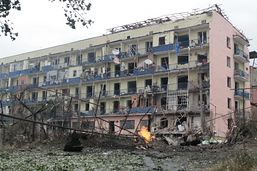
- An apartment building, damaged by a Russian air strike,
in the northern
- Georgian town of Gori, Saturday, Aug. 9.
- Why this war? This is the question my people are asking.
This war is not of Georgia's making, nor is it Georgia's choice.
-
- The Kremlin designed this war. Earlier this year, Russia
tried to provoke Georgia by effectively annexing another of our separatist
territories, Abkhazia. When we responded with restraint, Moscow brought
the fight to South Ossetia.
-
- Ostensibly, this war is about an unresolved separatist
conflict. Yet in reality, it is a war about the independence and the future
ofGeorgia. And above all, it is a war over the kind of Europe our children
will live in. Let us be frank: This conflict is about the future of freedom
in Europe.
-
- No country of the former Soviet Union has made more progress
toward consolidating democracy, eradicating corruption and building an
independent foreign policy than Georgia. This is precisely what Russia
seeks to crush.
-
- This conflict is therefore about our common trans-Atlantic
values of liberty and democracy. It is about the right of small nations
to live freely and determine their own future. It is about the great
power struggles for influence of the 20th century, versus the path of
integration and unity defined by the European Union of the 21st. Georgia
has made its choice.
-
- When my government was swept into power by a peaceful
revolution in 2004, we inherited a dysfunctional state plagued by two
unresolved conflicts dating to the early 1990s. I pledged to reunify my
country -- not by the force of arms, but by making Georgia a pole of
attraction. I wanted the people living in the conflict zones to share
in the prosperous, democratic country that Georgia could -- and has --
become.
-
- In a similar spirit, we sought friendly relations with
Russia, which is and always will be Georgia's neighbor. We sought deep
ties built on mutual respect for each other's independence and interests.
While we heeded Russia's interests, we also made it clear that our independence
and sovereignty were not negotiable. As such, we felt we could freely
pursue the sovereign choice of the Georgian nation -- to seek deeper integration
into European economic and security institutions.
-
- We have worked hard to peacefully bring Abkhazia and
South Ossetia back into the Georgian fold, on terms that would fully protect
the rights and interests of the residents of these territories. For years,
we have offered direct talks with the leaders of Abkhazia and South Ossetia,
so that we could discuss our plan to grant them the broadest possible
autonomy within the internationally recognized borders of Georgia.
-
- But Russia, which effectively controls the separatists,
responded to our efforts with a policy of outright annexation. While we
appealed to residents of Abkhazia and South Ossetia with our vision of
a common future, Moscow increasingly took control of the separatist regimes.
The Kremlin even appointed Russian security officers to arm and administer
the self-styled separatist governments.
-
- Under any circumstances, Russia's meddling in our domestic
affairs would have constituted a gross violation of international norms.
But its actions were made more egregious by the fact that Russia, since
the 1990s, has been entrusted with the responsibility of peacekeeping
and mediating in Abkhazia and South Ossetia. Rather than serve as honest
broker, Russia became a direct party to the conflicts, and now an open
aggressor.
-
- As Europe expanded its security institutions to the Black
Sea, my government appealed to the Western community of nations -- particularly
European governments and institutions -- to play a leading role in resolving
our separatist conflicts. The key to any resolution was to replace the
outdated peacekeeping and negotiating structures created almost two decades
ago, and dominated by Russia, with a genuine international effort.
-
- But Europe kept its distance and, predictably, Russia
escalated its provocations. Our friends in Europe counseled restraint,
arguing that diplomacy would take its course. We followed their advice
and took it one step further, by constantly proposing new ideas to resolve
the conflicts. Just this past spring, we offered the separatist leaders
sweeping autonomy, international guarantees and broad representation in
our government.
-
- Our offers of peace were rejected. Moscow sought war.
In April, Russia began treating the Georgian regions of Abkhazia and South
Ossetia as Russian provinces. Again, our friends in the West asked us
to show restraint, and we did. But under the guise of peacekeeping, Russia
sent paratroopers and heavy artillery into Abkhazia. Repeated provocations
were designed to bring Georgia to the brink of war.
-
- When this failed, the Kremlin turned its attention to
South Ossetia, ordering its proxies there to escalate attacks on Georgian
positions. My government answered with a unilateral cease-fire; the separatists
began attacking civilians and Russian tanks pierced the Georgian border.
We had no choice but to protect our civilians and restore our constitutional
order. Moscow then used this as pretext for a full-scale military invasion
of Georgia.
-
- Over the past days, Russia has waged an all-out attack
on Georgia. Its tanks have been pouring into South Ossetia. Its jets have
bombed not only Georgian military bases, but also civilian and economic
infrastructure, including demolishing the port of Poti on the Black Sea
coast. Its Black Sea fleet is now massing on our shores and an attack
is under way in Abkhazia.
-
- What is at stake in this war?
-
- Most obviously, the future of my country is at stake.
The people of Georgia have spoken with a loud and clear voice: They see
their future in Europe. Georgia is an ancient European nation, tied to
Europe by culture, civilization and values. In January, three in four
Georgians voted in a referendum to support membership in NATO. These aims
are not negotiable; now, we are paying the price for our democratic ambitions.
-
- Second, Russia's future is at stake. Can a Russia that
wages aggressive war on its neighbors be a partner for Europe? It is
clear that Russia's current leadership is bent on restoring a neocolonial
form of control over the entire space once governed by Moscow.
-
- If Georgia falls, this will also mean the fall of the
West in the entire former Soviet Union and beyond. Leaders in neighboring
states -- whether in Ukraine, in other Caucasian states or in Central
Asia -- will have to consider whether the price of freedom and independence
is indeed too high.
-
- Mr. Saakashvili is president of Georgia.
-
- See all of today's editorials and op-eds, plus video
commentary, on Opinion Journal.
|
